Email:
R-mail powered

Friday, November 24, 2006

Koeln Karneval

A few weekends ago was the official opening day of Karneval, which, although celebrated in some small way in a few other German towns, is taken very seriously in Koeln, and is one of the city's claims to fame. (In fact, when when I studied German at the Goethe-Institut and we learned some German geography, Koeln was marked on the map with some grinning Karneval clowns, floating around the spires of the huge cathedral, which is also famous.) The main event takes place for six days or so in February, just like Mardis Gras, but for some reason the "season" starts with a one-day event that kicks off, cleverly, at 11:11am of 11/11.

I'll do more research into the history of Koeln's version of this bacchanal when February rolls around, but I thought I'd just share some pictures from the Nov. 11th preview. I didn't show up until about 12:30pm, due to rain, so I missed the kickoff. I was in the touristy part of town with Roman, a friend from Stony Brook, whose camera I used, having forgotten my own. The main attraction initially was the hoards of people, ranging from early teen to senior citizen, all costumed up. My favorites were the groups of older women in matching outfits, like the pudding-cup ladies you can see here. But there were of course plenty of young folk about as well.

Not included in these pictures (remember--click on them to make them bigger and better) are some of the more eye-catching costumes, like a bunch of gorillas chained together, or a man with a suit made entirely of yarn. I also had a long chat with a youth dressed as a "Polish cleaning lady," which he explained was synonymous with "cleaning lady" (Putzfrau).

My costume, if we can call it that, consisted of leaves of ivy I pulled up from the planters in front of my building and stuck in my hat. I also had dressed in brown so that I might be mistaken for a tree, but I think I was taken as more of a wine-god. Unsophisticated as my get-up was, I still attracted some enthusiasm, particularly but not exclusively from middle-aged ladies, several of whom felt it necessary to caress my leaves. By the end of the evening most of them were gone (the leaves, not the ladies), having been plucked by people who assumed they were on offer. You can see the Leaf Hat below, at late and later stages of deconstruction; the Red Hat belongs to Irene, a philosopher-friend who joined us late in the afternoon.


Evening settled in, and our attention was drawn to the brass bands down by the river, playing traditional Karneval music, which I don't have a handle on yet, as well as compelling arrangements of classic rock tunes. Here's a shot from that phase of the evening, where you can see a small portion of a large group of feathered ladies shaking it up, perhaps to brass "Smoke on the Water," or brass "My Life" by Billy Joel (aka Bosom Buddies theme song).


Our night wound down in a small bar into which too many people were crammed dancing to incredibly cheesy music. By incredibly, I mean that "Celebration" sounded in that context like the funkiest groove you've ever heard. A lot of the songs seemed like techno versions of traditional Karneval songs; at least, some had "Colonia" in the lyrics, and the locals sang along fervently. An incident: a lady (about my age) shout-mumbled some things to me that I couldn't understand, until she finally said in English "I want you to dance with me." This didn't seem like a problem, since I was already dancing next to her, or at least bobbing slightly, so I turned in her direction and waved my beer around festively. This was apparently unsatisfactory, since, after some more shout-mumbles, she placed my hand on her butt. I've never had to politely remove my hand from someone's behind before, but I think I managed it with some grace. 5 minutes later she was making out with some other guy, so I doubt her feelings were hurt.

This is what the streets looked like at the end of the night.

Monday, November 06, 2006

Archiv Fever


I thought I'd offer a little tour of the Husserl-Archiv, which is one of the main reasons (and the primary justification) for my being in Cologne this year. A little history, as I understand it:

The philosopher Edmund Husserl (pictured, young and old) died in Freiburg in 1938, leaving behind a somewhat excessive 40,000 pages of manuscripts, written in shorthand. Husserl was of Jewish heritage, and although he had converted to Christianity he was naturally forced to retire from the university in the mid-1930s as the National Socialist program took over. (Heidegger, who was Husserl's pupil and who dedicated Being and Time to him, was Rector during this period, and authorized the action. Husserl was heartbroken.) After his death, his students were concerned that his unpublished works would be destroyed if they remained in Germany. So a Franciscan named Herman Leo Van Breda transported the entire collection, in diplomatic pouches, to Leuven, Belgium. The first Husserl Archive was founded at the university there in 1939. That archive remains the central institution; other archives now exist in Paris, Freiburg, Cologne (founded 1951), and at the New School and Duquesne University.

As far as I can tell, Cologne's archive is the most active after Leuven, by which I mean that there are scholars here actually working to edit and publish the material (in coordination with Leuven). The resulting texts come out as volumes in a series called "Husserliana." Here at the archives they have Husserliana in its entirety, a ton of secondary material, and a cabinet with all or nearly all of the manuscripts that have been transcibed from shorthand to typed pages: some are copies from Leuven and some "original" transcripts. There are also some of the handwritten pages, and maybe some microfiche somewhere, but I haven't actually seen those (nor could I read them if I did--it takes a few months to learn the shorthand, apparently.)


Here is the building from the outside. Not bad, when you consider the picture that was chosen (appropriately) to represent the university itself on Uni Koeln home page:

The Archiv itself is in the basement, but it's cheerful enough and gets some light. Here's the main reading room, where I work, and where all the books are:


Today was the first time I actually asked for something from the manuscript cabinet. I had a meeting last week with Herr Dieter Lohmar, the professor who runs the Archiv, in which I asked him where I might look for Husserl's discussions of a number of issues, primarily "Zeitobjekte"(time-objects), causality, and "Sachverhalte"(states-of-affairs). He gave me some cryptic codes that I scribbled down without fully understanding. Today I showed one of these codes [A VII 14, 21-29] to Dirk, a young scholar who works here, and he was able to figure out what I needed. We went together to this room:


The cabinet against the wall contains the transcribed pages. It may not look like much, but there are really a lot of pages in there. Here--look closer:


I was given a folder with a bunch of pages in it (including the ones I wanted). I can't photocopy them unless I have ultra-extra-special permission. So I set to work at one of the tables in the main room, taking notes and entering words into my German-English dictionary software. After a couple of hours I got drowsy (I had already sat through a long seminar on Schellings Philosophie des Absoluten), so I just left the folder on the table where it will be waiting for me tomorrow. I biked home and bought some celery root and raviolis, which I cooked and ate with my roomate Stefan.

Tuesday, October 24, 2006

Three Kings, 11,000 Virgins

This black and white picture hangs in a stairwell in the main building of the Universitaet Koeln. I took my picture of it today after attending a class on Causality. You may be wondering why the 600 year anniversary of the university was commemorated by a picture of bathroom door icons performing a nativity scene. Well.

It turns out that one of the ways Cologne became an important city in the middle ages was through its acquisition of numerous Christian relics. Thousands of pilgrims would make the trip to Cologne every year to see or be near these marvels, the most important of which were the supposed bones of the Three Kings. These bones had somehow made their way to Milan, but were seized by Holy Roman Emperor Frederic Barbarossa, and given by him to the Archbishop of Koeln, Rainald of Dassel, in 1164. (The archbishops of Cologne generally got along well with the Emperor and/or Pope, receiving all sorts of nice things besides relics, like customs duties for travel on the Rhine and the right to use coins.)


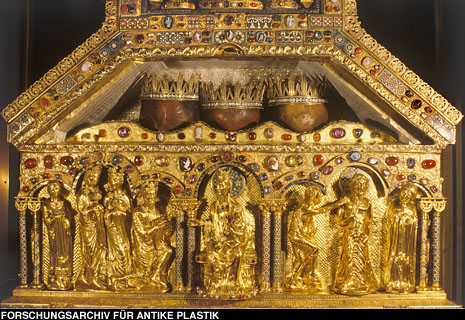
The popular medieval goldsmith Nicholas of Verdun designed the shrine for these bones, which, judging from the photo of it, allows a little peek at the King's craniums, outfitted with crowns and rather cutely huddled together. (I didn't notice that when I saw it recently; the viewing angle is a little weird.) Construction of the cathedral to house the shrine began in 1248, and continued swiftly for about 100 years, then slowed down over the next 200 years and halted completely in 1560. The Gothic revival of the 19th century picked up where things had left off, and construction was wrapped up in under 40 years, by 1880.

In any case, the three kings have long been a city symbol for Cologne. Thus their incorporation into the university propaganda, as well as Cologne's coat of arms, which has three crowns at the top.

Beneath the crowns you'll see 11 black flames. These symbolize the martyrdom St. Ursula and her 11,000 virgin companions. It happened like this (well, probably not): The English Princess Ursula was passing through Cologne with 11,000 virgins. The city was at the time occupied by the Huns, and when Ursula refused to marry their heathen leader, everyone was killed. The number 11,000 was a late addition to a story which initially included only 10 virgins. There are a number of interesting theories as to how the number got inflated, involving e.g. misreading of latin abbreviations or the necessity of accounting for an abundance of "relics." The few of you who might be interested can read about them here.


Note also that the coat of arms for the British Virgin Islands has 11 lamps, surrounding a woman with a lamp. Columbus discovered these islands after being blown off-course sometime after 1493. All the tiny islands and rocks dotting the ocean around the main islands reminded him of the 11,000 murdered virgins. Naturally. He named them Santa Ursula y las Once Mil Vírgenes, shortened later to Las Vírgenes.

I don't know exactly why flames and lamps are used to represent Ursula and her crew, but I imagine it harkens back to the vestal virgins and the flame they tended. That's just a guess.

Monday, October 16, 2006

Der Vierte Radfahrer (The Fourth Biker)


A short film wherein I bike past Timo and Verena (new acquaintances), and then Eva (roommate) waves.

Bicycles are so ubiquitous here that you can buy them at the supermarket. That's where I got mine (pictured). It's not such a bad one, either.

Thursday, October 12, 2006

Lighthouse Mystery Solved


The thing that looked like a lighthouse (see two posts ago), looks even more like a lighthouse at night. It is, in fact, a lighthouse of sorts, or at least a mock one. It was built around the turn of the century, I believe, as a flashy addition to the headquarters of the electrical company Helios Elektrizitäts AG. The building now houses a couple of furniture stores and a bike shop.

Tuesday, October 10, 2006

Weekend in Berlin


Just got back from a weekend in Berlin, where my friends Nora and Arne have a beautiful new apartment in Prenzlauer Berg. They were still putting together shelves and such, as you can see. The other picture is of an apartment block in Ernst-Thälmann-Park, near their place. Clicking on these pictures opens up higher-quality versions, by the way. You'll find a few more pictures here, mainly of Nora and Arne putting together the same shelf, and of the VW factory in Wolfsburg, taken from a train.

Tragically, I don't have pictures of the coolest new place in town, the "Rodeo" bar and restaurant. When I was in Berlin last year, my friends took me to a little "illegal" restaurant called Rodeo in an abandoned apartment building. The operation was eventually kicked out of that location, and after moving to another spot the organizers somehow got their hands on the old post office, an incredible brick building with a huge domed room in the center. Unbelievable. People dine under the dome (now legally) and party in the side rooms. Comfortingly, the crowd was mostly early-30-ish.

I also went with my philosophy friend Chris to a little bar called CCCP where they were playing 78's from the '20s, and the staff was dressed to the nines in tuxedos and pearls. Good thing I'm not living in Berlin; I'd never get any work done.

Tuesday, October 03, 2006

moved in!


So I moved in to my room in Ehrenfeld, a great neighborhood in the NW part of the city. Lots of Italian and Turkish people milling about, as well as Germans and some other Volk and me. It is supposed to be an "ex-industrial" part of town, but I haven't seen many signs of heavy industry yet. You can see something from our kitchen window that looks like a lighthouse, although there is no water nearby (see picture to left). The neighborhood is also supposedly somewhat hip, but I haven't poked around for that sort of thing yet. There do seem to be hip people around.

The other two pictures above are of my workspace in progress and our kitchen table. I have a set on flickr with a few photos of Köln and my apartment.

My roomates are Eva (27) and Stefan (30). They are both extremely nice, fun, relaxed people who have helped me immensely in the few days since I've moved in (bedding being key, as well as tours around the neighborhood and borrowing of bikes). I'll get some pictures of them soon and put them up here.

Köln seems like an excellent city so far. Compact, lively yet relaxed, lots of bike paths and parks, and buildings that, when a bit structurally dull, are at least painted in cheerful pastels. You can find some nice old buildings too, but most of the Altstadt is gone as far as I can tell. There are some Roman ruins, though--sewers and such. How about that?